
Publish, Perish or Progress...
The pressure, pitfalls and promise of reform in oral, dental and craniofacial research


We read and use the scientific literature to inform how we practice and provide care for patients and we implicitly understand that not all research is created equal.
But WHY that is the case? Why do we not allow only the very best science to be published in our journals?
Surely this would save all the complexities around critically appraising work as we read it (and yes, high-quality critical appraisal is hard indeed and we’re not going to talk about peer review here at this time – one for a later post!). We would only need to apply what is useful and applicable to our patients rather than make decisions over veracity and quality of research?
Publishing research serves 2 purposes: it is the cornerstone of scientific communication, how we share findings and discoveries, how we build on existing knowledge, but it also acts as a currency as it provides a proxy measure for scientific standing. In the absence of universally accepted measures of a researcher or academic’s quality, metrics like journal impact factors and citation counts have become the default yardsticks for career progression, funding, and institutional recognition.
But this system is showing cracks.
A Boom in Dental Publications - But at What Cost?
Over the past two decades, the volume of publications in oral and dental research has surged. Bibliometric studies alone have grown at an annual rate of over 17%, and journal impact factors have steadily increased. While this reflects a thriving field, it also signals a growing strain on peer review systems and editorial standards.
The pressure to publish has led to a proliferation of low-quality studies. Some are poorly designed, some badly carried out, others lack clinical relevance. And where there's pressure, there's an opportunity for exploitation.
Increase in Journals
According to Scopus data (using Scimago journal ranks from 2025, there are currently 271 indexed journals in the field of dentistry, oral surgery, and oral medicine. This represents an almost 3-fold rise from 115 journals in 1999. This is high compared to all scientific journals, which have not even doubled in number (from 17000 to 31,000).
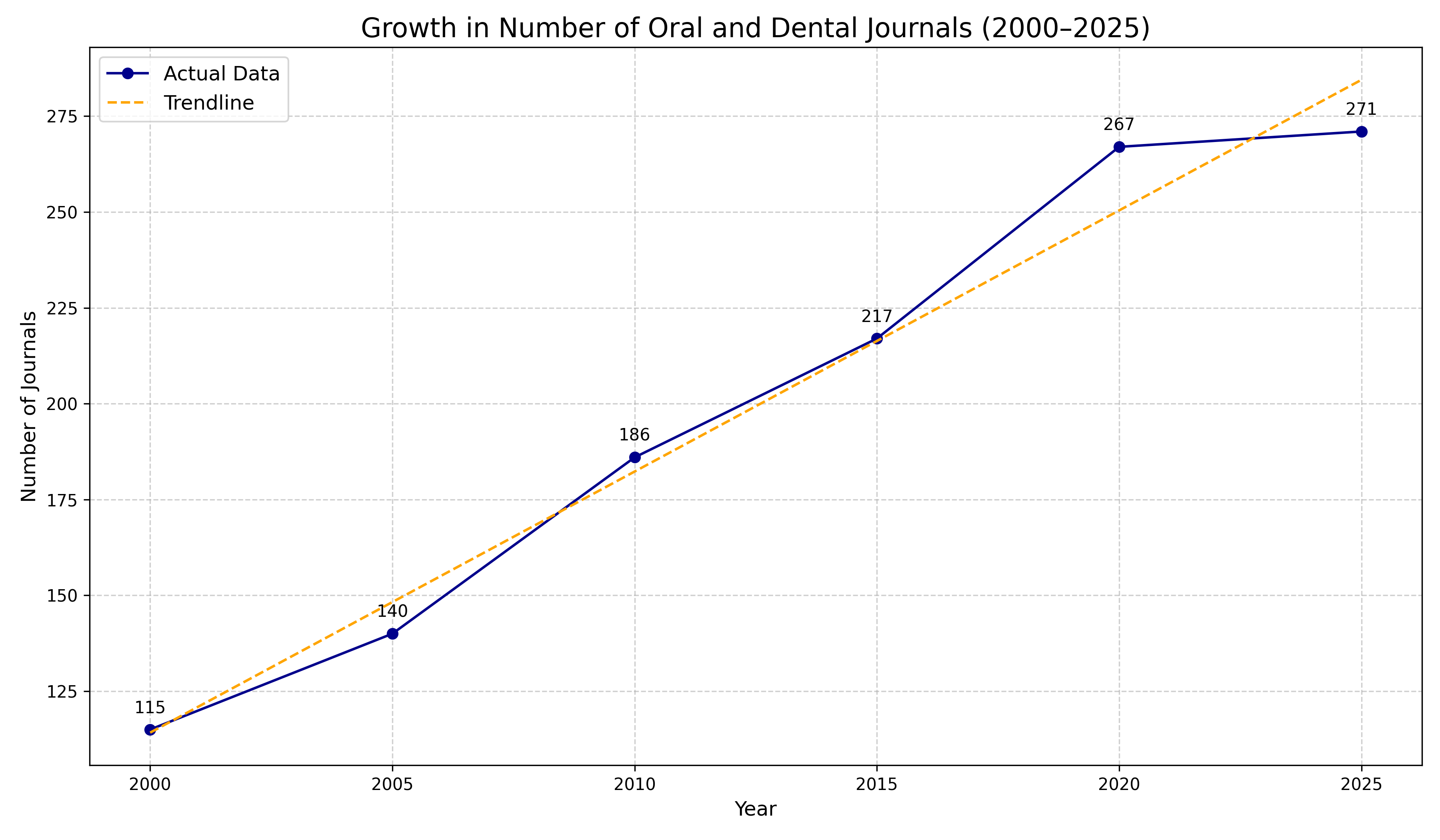
The Expanding Landscape of Dental Research: Number of Oral and Dental Journals from 2000 to 2025
This growth reflects both the expansion of global research activity in oral health and the diversification of subfields within dentistry, such as implantology, endodontics, and dental materials. However, it also raises concerns about the sustainability of peer review systems and the potential dilution of quality across a rapidly growing publishing landscape.
Enter the Paper Mill
Compounding the problem, we have seen the rise of the paper mills (https://en.wikipedia.org/wiki/Research_paper_mill ): commercial entities that have low quality thresholds for publishing scientific research. These also fabricate or sell authorship on scientific papers. A 2022 study found that over 1,100 papers were retracted due to paper mill activity, with nearly 800 retractions in a single year - accounting for over 20% of all retractions globally ( https://www-bmj-com.cardiff.idm.oclc.org/content/379/bmj-2022-071517 .
These operations can sometimes offer ghost-writing, fake data, and guaranteed indexing in reputable databases. Prices range from a few hundred euros to over €5,000 per paper. Some even promise publication in journals indexed by Scopus or Web of Science, with confidentiality guaranteed.
The result? A flood of low quality and even fraudulent research that undermines the credibility of the scientific record.
While paper mills have been widely documented across biomedical and life sciences, their presence in oral and dental research is increasingly suspected but not yet fully quantified. The rapid expansion of dental journals, nearly tripling over the past two decades, combined with mounting pressure to publish in indexed outlets, creates fertile ground for unethical practices. Paper mills exploit this environment by offering fabricated manuscripts, authorship for sale, and guaranteed indexing, often targeting researchers in regions with high academic output requirements. Although no comprehensive study has yet isolated paper mill activity specifically within dentistry, the inclusion of dental journals in mass retractions from publishers like Hindawi suggests the field is not immune. This underscores the urgent need for stronger editorial oversight, transparent peer review, and adoption of responsible research assessment frameworks like DORA.
Open Access: Democratising Knowledge or Fuelling the Fire?
Open access (OA) publishing is an effort to make research more accessible, especially for low- and middle-income countries. But it comes at a cost—literally. Article Processing Charges (APCs) can exceed $3,000 per paper, creating financial barriers for many researchers.
This economic pressure, combined with the "publish or perish" culture, has made paper mills an attractive—if unethical—shortcut for some.
DORA: A Beacon of Reform
The San Francisco Declaration on Research Assessment (DORA), launched in 2012, aims to change how research is evaluated. It calls for:
• Eliminating journal-based metrics like impact factors in hiring and promotion;
• Evaluating research on its own merits, including datasets, software, and societal impact; and
• Promoting transparency and inclusivity in assessment practices.
Over 20,000 individuals and institutions have signed DORA, using narrative CVs and broader criteria to assess research contributions. My own institution Cardiff University signed up to it in 2019 and is making considerable efforts towards its implementation.

Can DORA Solve the Problem?
DORA offers a compelling alternative to metric-driven publishing. By shifting the focus to quality and impact, it:
• Reduces incentives for unethical practices;
• Encourages diverse outputs, including policy work and public engagement; and
• Restores trust in the integrity of scientific publishing.
Institutions that embrace DORA report fairer evaluations and better alignment with mission-driven research.
But DORA Isn’t Perfect
Despite its promise, DORA faces criticism:
• Lack of clear alternatives: Replacing impact factors with robust, universally accepted metrics is challenging;
• Inconsistency: Some institutions sign DORA but still participate in global rankings that rely on flawed metrics; and
• Complexity: Reforming entrenched systems requires time, training, and cultural change.
Barriers to Implementation
Key obstacles include:
• Institutional inertia: Traditional metrics are deeply embedded in academic culture;
• Disciplinary variation: Different fields value different outputs, complicating standardisation; and
• Resource constraints: Qualitative assessments require investment in training and infrastructure.
Conclusion: Reform Is Possible But It Will Take Commitment
The surge in dental publications, the reductions in publication quality, the rise of paper mills, and the financial pressures of open access publishing highlight the urgent need for reform. DORA offers a principled framework to restore integrity and fairness in research assessment. But its success depends on consistent, well-resourced implementation and a collective willingness to rethink what we value in science. A tall ask in the current climate of academic austerity.